
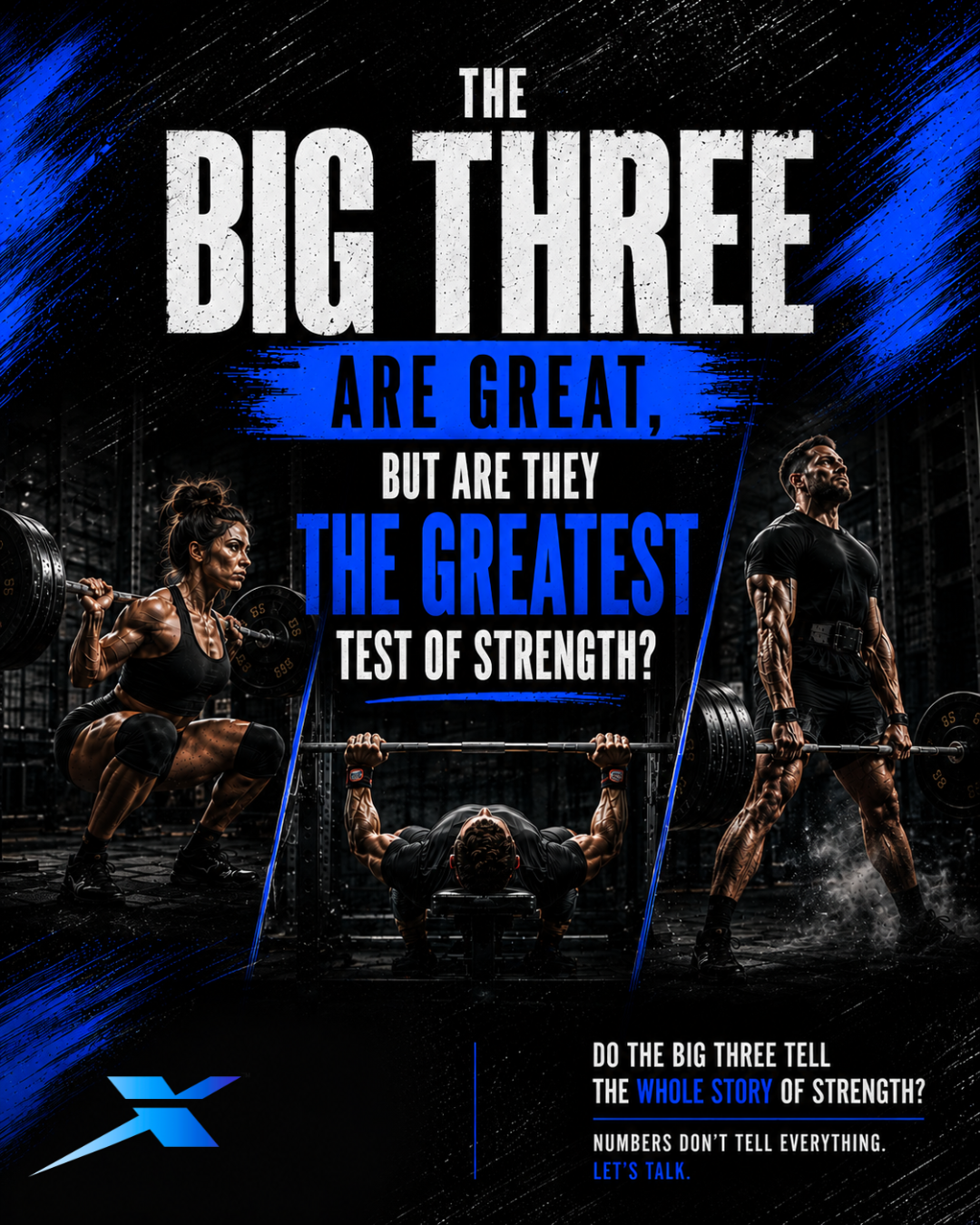
The squat, bench press, and deadlift have defined strength culture for decades. But here’s a question the fitness world rarely stops to ask: who decided these were the ultimate tests and why?
The “big three” didn’t earn their throne through rigorous scientific debate. They rose to dominance because they were practical, scalable, and easy to standardize. That’s a perfectly good reason to train with them but it’s not the same thing as proving they’re the definitive measure of human strength.
Modern biomechanics is starting to catch up with what athletes have quietly known for years: the human body is far more complex than a barbell can account for.
“Tools are not the same thing as perfect measurements.”
The Body Doesn’t Move in Straight Lines
Real human movement happens across multiple planes, through rotation, asymmetrical loading, and changing leverage. The big three simplify all of that into relatively constrained patterns which is exactly what makes them useful for building a foundation, and exactly what limits them as a complete picture of strength.
The Hidden Limitations
Take the squat. How deep you can go, how upright your torso stays, whether your knees track properly all of it is heavily shaped by your limb length, hip anatomy, and ankle mobility. Some athletes are structurally built to squat. Others simply aren’t. That’s not a weakness. It’s biology.
The bench press measures horizontal pressing force in a single fixed plane. But the shoulder joint is one of the most mobile structures in the human body. Real-world pushing strength doesn’t happen on your back with your feet planted.
The deadlift is brutally effective few exercises demand as much from the posterior chain. But it’s also constrained by spinal loading, leverage, grip fatigue, and anthropometry. It measures one very specific type of force production, not strength in its totality.
So What Does “Strength” Actually Mean?
That’s the question performance science is increasingly forcing coaches, trainers, and athletes to confront. What is strength:
Maximal force output?
Rate of force development?
Eccentric control?
Rotational power?
Stability under load?
Neurological efficiency?
The answer is probably all of the above and the tools we use to build and measure it need to reflect that.
The future of strength training isn’t abandoning the classics. It’s expanding what we ask of the body.
Where the Field Is Heading
Elite programs are already moving in this direction incorporating variable resistance, accommodating resistance, eccentric overload, multi-planar mechanics, and velocity-based training. The goal isn’t to replace the squat, bench, and deadlift. It’s to stop treating them as the ceiling.
At Perform-X, we’re built around this idea. Our equipment is designed to take athletes beyond the traditional weight room adding variable resistance to the movements they already train, and opening up planes of motion, loading patterns, and explosive qualities that standard barbells can’t touch.
The big three are great tools. They always will be. But the best athletes in the world aren’t training in straight lines.
Let’s Talk About It
Do you think the big three are still the gold standard or is it time to rethink what strength really means? Drop your take in the comments or join the conversation on Instagram: Perform-X Instagram Now
#BuildingBetterAthletes #GoBeyondTheWeights #StrengthScience #PerformX #FindYourInnerAthlete #BigThree #StrengthTraining #PerformanceTraining
Perform-X
Perform-X
Perform-X
Perform-X